


Author’s note: what follows below is an amateur blogger’s use of Web research and social media to communicate with women living in Saudi Arabia in order to better understand their lives and ability to achieve personal fulfilment. I received responses from women living in Wahhabist Families (Majida, Letifa, Rasha, Qadira, Liesha, Lulu, Mumtaz), Conventional Saudi Fundamentalist Families (Ketifa, Khalilah), Practicing but not devout Families (Lamis, Layia), Non-devout/Non-believer Families (Maisha, Marjani) and “Extreme Shiaa” Families (Saarah). Their stories of oppression and, in many cases, physical, mental and spiritual abuse are something free people can no longer guiltlessly ignore.
In this first of three blogs, I have decided to let these heroic women’s testimony speak for itself unedited. I expect that like myself, you will find their stories heartbreaking, but also inspiring due to their spirit, creativity and sense of humor (for example, see Rasha’s and Mumtaz’s responses below.) For their protection, I have applied pseudonyms to all of the respondents…
—————————————————————————-
What is your daily life in Saudi Arabia like?
Ketifa: “It’s agony. I can’t do anything on my own. Every single action i wanna take/make must be revised and corrected. Males have the superiority in every aspect of life here. I just wish i was born in a normal society, society that treating me as a human being not a subject or a tool. Being different here is torture.”
Khalilah: “In short, I cannot make the simplest choices in my life. I can’t leave home whenever I want. When I need something, I have to ask male family members to drive me the place I need, and usually they refuse, have a long discussion about it, list 100 reasons to why I should need to leave the house ( as if im not supposed to have needs, things to get done ), once i get blessed with their approval, they often stall and put off my needs aside for a few days/weeks. But once they feel the need to get their things done, they get up, drive their own cars, visit their friends whenever they want wherever they want, BUT I CAN NOT. I even stopped accepting invitations from my friends and colleages, because no one is willing to gove me a lift. I am forbidden from using taxi, or go out by myself. Im 28, soon to be 29 and im treated as in literary a prison. I dont feel im treate dmatured, i feel im looked down at, they think I can be easily manipulated. I got my master’s in ksa, i want to get my P.HD somewhere abroad, but no! This is not a choice of mine. Im successful, i studied hard, i worked hard, i work harder, but at the end whom I fooling myself! Im saudi women whose her life eternally chained to the moods and whims of men around her. Even when I wanted to volunteer, to be sending good vibes back to the society and help the needy, i go NO for that, i wanst allowed to volunteer.
The funny thing, im engaged, and guess what, to a man that i’ve never seen and he has never seen me! I honestly dont know what a future for a successful (I) be like in the future.
The only things i can do is, work (as a lecturer), breathe, eat, endure all the insluts, bear all the mistreatment, cry my eyes out, and sleep.”
Majida: “I could hav been a great many things if wasn’t a Saudi woman.”
Saarah: “At home all day unless weekends when we gather at my grandfathers house – Trying to find a job at my husbands and family strict specifications ! living in fear everyday of them knowing that I am not Muslim anymore and that I have to pretend to be praying every single day and soon to be fasting ! Severely depressed and anxious for my situation that I could not do anything with ! I have to pretend to be muslim and wear the shitty abaya and niqaab and even black socks when ever I go out and still at the same time I have to take care of my psychological health.”
Maisha: “Struggle fear”
Letifa: “I could sometimes go out only if father allow me, i am forced to wear niqab and even with me wearing niqab my brother tell me to cover my eyes, i could not live alone i will live with my family tell i get married, i could not travel alone and i have never travel, i fell like slave only eat, clean and sleep. Thankfully my family allow me to go to university unlike some other saudi women”
Rasha: “sit at home aĺl day pray for the magical wond …i mean husband to make all my wishes come true. wear ninja suit outside the house. goes out onece or twice every 3 to 4 months to the supermarket to buy personal stuff.”
Qadira: “Since I finished school, I’m only allowed to go out in the weekend, so imagine having to stay at home for 6 days with nothing to do except sleep or eat. We’re not living our lives we’re just surviving.”
Liesha: “I had a really rough life because in my case I wasn’t abused by my father I was abused by my mother who turn my father against me because she want me to get married she crushed all my dreams abuse me physically and mentally he and when I wanted to study aboard my father was OK with it but she manipulated him and he refused later because of male guardianship I couldn’t leave and I still can’t believe I’m forced to live in this country that treat women as property”
Marjani: “Horrible Nightmares I wish I could leave this country forever I wish I didn’t born as a woman at all”
Layia: “Growing up in Saudi arabia was a challenge. You know that at a certain age you were going to start covering up from head to toe. And this to me was terrifying. I didn’t want to see the world thro a veil. Also the gender segregation and sexism within thr cuminnity was traumatizing. The boys you grew up with, you can’t see anymore because now you’re a full-grown woman and your appearance it’s provocative to men.”
Lulu: “I’m an Atheist women who live in Saudi Arabia unfortunately so I have two types of struggles, as a women I’m forced to study a speciality that I don’t like just because my family want me to study it, I am forced to cover up all my body even my face, recently my family are planning to force me to marry someone I don’t know but I’m lucky cuz my male guardian didn’t force me to marry him and this is really scare me if he changes his mind or if he dies. As a women I can’t transport alone cause Saudi women driving is a crime add to that my family are very strict so they don’t let me walk.”
Lamis: “No major or real role for women here, for the most of the important decisions I have no opinion in them, the court system is the main Cause of all problems, it’s 100% male biased, by not discussing it and focusing on minor subjects it’s a waste of time.”
Mumtaz: “My family is very strict. I’m only allowed to go out of the house to work and on rare occasions to the mall which is the only place of entertainment to women, at least women of the working class. I have no say in the way I dress. I was refused to study medicine even though I was an A+ student. I am not allowed to choose my future husband. I will be forced to marry some polygamist like my sisters. At some point of my life, I was not allowed to buy my own underwear. I am not allowed to travel and I don’t have a passport. What I could do? Hmmm… I could pee without them knowing. Does that count?!”
—————————————————————————————————————-
My research demonstrates that many women living life under the burka, abaya and niqab are often not submissive, fundamentalist Muslims. Instead they reject the lifestyle to which they are subjected, but are powerless to change their circumstances. Imagine yourself a free-thinking Saudi woman confined to live a life under those garments of enslavement and oppression with no control over the key decisions in your life. Could you bear such an existence?
Cynics may say my research methods are unsound or unscientific. I verified each respondents’ IP address location matched their written response to survey question regarding current residence. More importantly, I ask readers to simply listen to the women’s voice and ask does this sound like mere contrivance? If so, under what motivation? Instead such cynics should ask themselves, “this testimony speaks of such a dark and bleak existence could it possibly be true?!” If so, what moral obligation does that put on us to investigate further and understand more? Cowering under willful ignorance is unacceptable, instead we must petition our governments and institutions to further understand what is going on, communicate it broadly and address it as soon as possible with every tool at our disposal.
In order to quantify Saudi Women’s ability to achieve happiness relative to our own in Western Societies it is useful to take a brief look at the social sciences. There are many theories and metrics for human happiness, but this summary of the classification of qualities of life by Ruut Veenhoven’s is useful:[i]
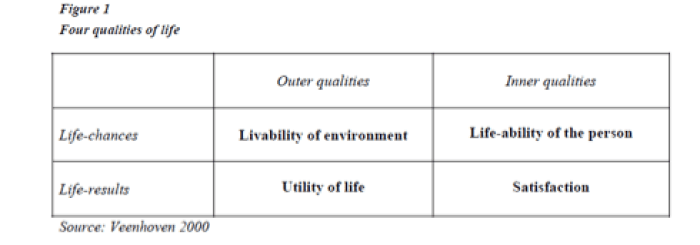
According to Veenhoven’s rubric the vertical axis captures the distinction between the probabilities of experiencing a fulfilled life “Life-chance” and the actual outcomes of one’s life “Life-results,” while the horizontal axis distinguishes be physical fulfillment on the left and emotional/psychological/spiritual fulfillment on the right. This matrix illustrates that the chances of any non-conforming Saudi woman to achieve a happy and fulfilled life are extremely low. In particular, their “life-ability” or ability to successfully adapt to their circumstances is very low due to Saudi Arabia’s “Male Guardianship” laws that require men to approve nearly every important decision in women’s life (not to mention other societal constraints.) “Utility of life” represents a humans’ ability to seek fulfillment in something beyond oneself or to pursue a higher value, but again here, Male Guardianship and other restrictions mean women usually cannot pursue their highest intellectual interests such as studying medicine and engineering or even engaging in volunteer work to benefit society. Finally, the bottom right component is the one closest to “life-satisfaction” or “happiness” which I interpret it to be a function of the other three components. With a minimum of two of the three scored very poorly It is necessarily so as well. In the case of a poverty stricken Saudi family, the top left quadrant would score low, with even lower chances for those women to achieve happiness.
In summary, descriptions of life for non-conforming Saudi women tell a tale of fear (“Struggle fear”, “this is really scare me if he changes his mind”), denial of the pursuit of happiness (“Even when I wanted to volunteer, to be sending good vibes back to the society and help the needy, i go NO for that, i wanst allowed to volunteer”, “as a women I’m forced to study a speciality[SIC] that I don’t like just because my family want me to study it”) and clinical depression (“The only things i can do is, work (as a lecturer), breathe, eat, endure all the insults [SIC], bear all the mistreatment, cry my eyes out, and sleep”, “I have to take care of my psychological health”, “Horrible Nightmares I wish I could leave this country forever I wish I didn’t born as a woman at all.”) At the same time suffering from this organized oppression occurs, our governments and corporations make deals with the Kingdom of Saudi Arabia (KSA) every day allowing the abuse to continue unabated. Now is the time for us to get involved and change they dynamic by continuing to communicate and build bridges with Arab women and demonstrate our concern for their welfare (modern technology makes this surprisingly easy to do.) As we continue to build our understanding of their suffering we must apply utmost pressure on all of our politicians and companies to forego business, trade and arms deals with KSA until major and tangible changes are made.
[i] “How do we assess how happy we are? Tenets, implications and tenability of three theories.” By Ruut Veenhoven (Erasmus University Rotterdam) Presented at the conference: New Directions in the Study of Happiness: United States and International Perspectives’, University of Notre Dame, USA, October 22-24 2006.
 FALSTAFF'S BRIEFS